
📅 Publicado el: September 19, 2024
🔄 Última actualización: August 3, 2025
Quality vs. Quantity in Goalkeeper Training

En el mundo del entrenamiento de porteros, surge una pregunta recurrente: ¿es más efectivo centrarse en la cantidad de repeticiones o en la calidad de las mismas? Este debate es especialmente relevante en las etapas formativas, donde establecer una base sólida es crucial para el desarrollo a largo plazo. En este artículo, exploraremos cómo priorizar la calidad en los entrenamientos puede marcar una diferencia significativa en el rendimiento y evolución de los porteros.
What is better, training more or training better?
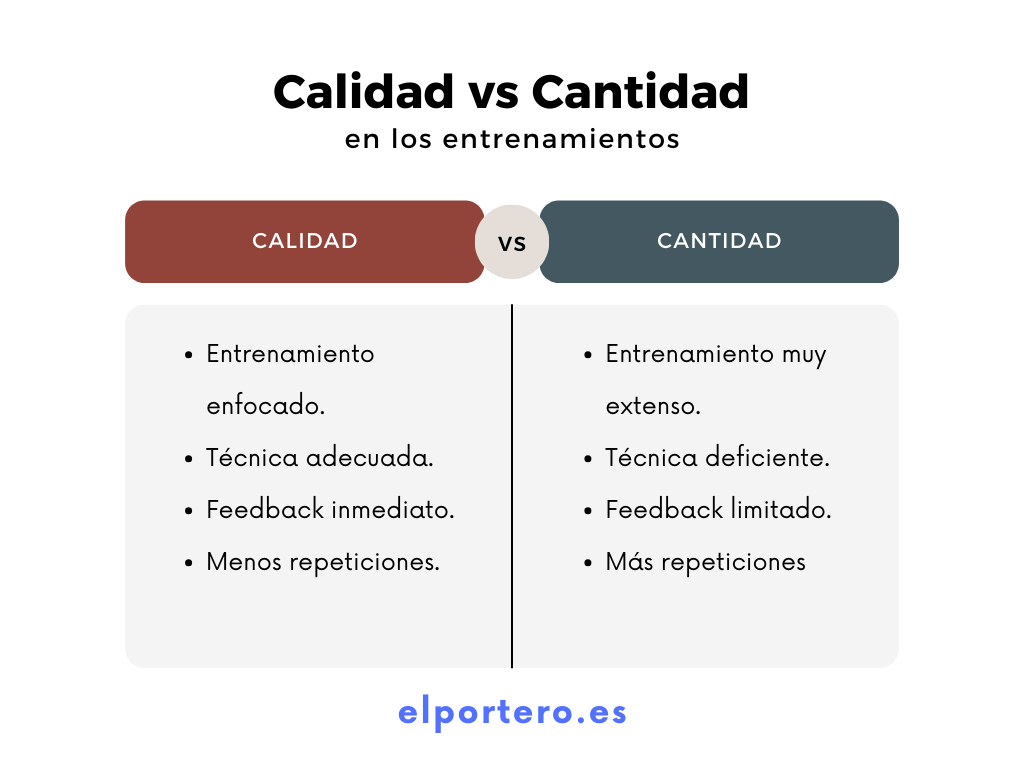
It's common to think that the more you train, the better the results. However, in goalkeeping training, quality trumps quantity. Repeating a technique incorrectly can reinforce bad habits, while focusing on precise and conscious execution of each exercise promotes meaningful learning.
For example, performing 20 repetitions of a technique with attention to detail and appropriate corrections is more beneficial than performing 100 repetitions without supervision or clear purpose. The key is to train with intention, understanding the "why" behind each action.
This makes even more sense when we understand the different key stages in goalkeeper training. Each stage of development requires a different approach, and if instead of adapting we just increase the volume, learning can become counterproductive.
How do we prioritize quality over quantity?
To focus on quality during goalkeeper training, consider the following strategies:
- Planning with purpose
Define specific goals for each session, such as improving blocking, exits, or decision-making. This allows you to select exercises that directly address the skills you want to develop.
In this sense, understanding how to plan training for children and adolescents is key to ensuring that the content is adapted to their training stage and learning pace.
- Exercises that generate feedback
Design drills that provide immediate feedback, allowing goalkeepers to identify and correct errors in real time. For example, in a blocking drill, establishing target zones can help assess the goalkeeper's accuracy and control.
You can also encourage self-correction through video analysis or active breaks where the goalkeeper reflects on his execution.
- Volume adjusted to level and age
Adjust the workload according to the goalkeepers' age and level. Younger players require more time to master techniques and need to avoid fatigue to maintain focus and motivation.
Here it is essential to know how to manage the load during training, to avoid falling into overtraining and prevent injuries, something especially important in the early stages.
- Specific quality exercises
Instead of taking numerous shots without context, focus on drills that simulate real-life game situations. For example, an "angle closure with decision-making" drill, where the goalkeeper must decide between going out to the ball or waiting, works on both technique and reading the game.
These types of exercises promote not only the goalkeeper's technical quality but also his tactical intelligence.
- Immediate and conscious correction
Provides immediate fixes, clearly explaining what needs to be adjusted and why. This makes it easier to understand and implement the necessary improvements.
Short breaks can also be introduced mid-task to allow the goalkeeper to reflect and reinforce what has been learned before continuing.
What benefits does this have for the goalkeeper in the long term?
Prioritizing quality in training offers multiple advantages:
- Lower risk of injury: Proper technique reduces the likelihood of injury from overuse or incorrect execution.
- Specific Performance Improvement: Goalkeepers develop more transferable skills to the real game, such as better decision-making and technical execution.
- Increased Confidence: Understanding and mastering techniques strengthens the goalkeeper's confidence in their abilities.
- Development of critical thinking: Encouraging reflection on one's own performance promotes autonomy and commitment to learning.
- Sustainability over time: A focus on quality maintains motivation and facilitates consistent, meaningful progress.
As goalkeepers internalize these advantages, their growth becomes more natural, progressive, and solid. In fact, a quality-focused training model facilitates the transition between formative and competitive stages, avoiding stagnation or setbacks due to overwork, lack of motivation, or acquired bad habits.
Conclusion
Quality must be the cornerstone of any training process, and even more so in goalkeeping, where the details make the difference. It's not about choosing between training a lot or a little, but rather training well. Well-focused training, with meaningful repetitions, conscious corrections, and clear goals, will always be more effective than training based solely on volume.
Remember: training with intention, purpose, and purpose is the best way to develop strong, technical goalkeepers who are prepared for the challenges of the real game.
 English
  Spanish