
📅 Publicado el: September 26, 2024
🔄 Última actualización: October 21, 2025
Complete Guide: Low Frontal Drops in Goalkeeping

Low frontal drops represent one of the most important skills a modern goalkeeper must master. Proper execution not only allows for the ability to stop balls at ground level, but also ensures safety, efficiency, and continuity in play. This type of intervention is key in many goal-scoring actions and, therefore, must be developed from the ground up, using a progressive approach that ensures a deep understanding of the technique. In this guide, we break down the analytical process for training this action, following a phased structure that facilitates its learning.
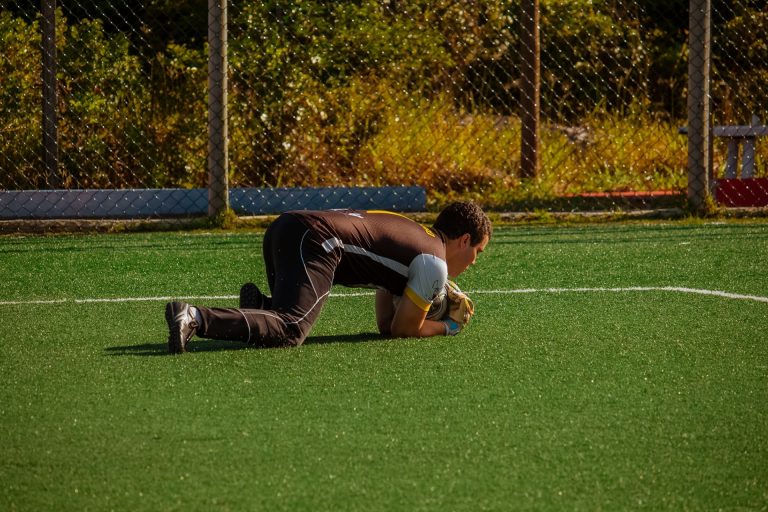
Step 1: Frontal shallow receptions from knees
The goalkeeper's first contact with the low front drop should be from a static and controlled position: on his knees. This position minimizes the risk of errors and allows him to focus on the essential technical aspects.
Main technical objectives:
- Learn the correct hand position for pocketing the ball.
- Coordinate the trajectory of the body in the forward fall.
- Develop confidence in ground contact.
From this position, the goalkeeper receives balls thrown directly at ground level. The focus is on "wrapping" the ball, protecting it with the body and absorbing the impact with the chest and arms. The forward lean of the trunk, the proper alignment of the neck, and the correct gaze are key details at this stage.
This phase is also an excellent place to start with complementary exercises such as frontal blocking exercises, which reinforce the blocking technique without displacement. In addition, the positioning technique is also worked on implicitly, since the goalkeeper must align himself correctly with the trajectory of the ball.
Step 2: Flat front landings from a standing position
Once you've mastered the kneeling technique, it's time to progress to a more challenging situation: landing from a standing position. This introduces the dynamic movement of lowering the knee, which involves coordination, balance, and reaction speed.
Two levels of difficulty arise in this phase:
- Controlled Knee Drop: The coach or trainer indicates in advance which way the ball will be thrown. The goalkeeper lowers one knee—usually the one closest to the ball—while keeping their body aligned and protecting the ball during the drop. The goalkeeper tries to internalize the gesture without thinking.
- Uncertain Fall: Now, the goalkeeper doesn't know in advance which way the ball will go. This variability introduces the component of real-time decision-making. The focus shifts from mere technical execution to the combination of perception and motor response.
At this stage, strength and body control work are essential. To achieve this, you can integrate lower body training routines that enhance your ability to take off, stop, and coordinate movements, all of which are essential for performing quick and controlled landings.
Step 3: Real situations of uncertainty
The final phase of the process places the goalkeeper in scenarios similar to those in the real game. There are no pre-determined signals or fixed positions. The ball can come from a pass, a shot, or an unexpected action.
Key aspects of this stage:
- Quick reaction without loss of technique.
- Interpretation of trajectories in milliseconds.
- Adaptation to contexts of pressure, rebounds or contact with opponents.
This phase can be performed in small-space work or through reaction speed exercises that simulate the uncertainty of the game. The objective is for the technique trained in the previous phases to appear automatically and efficiently, even when the goalkeeper is in motion or after a previous action such as a pass or an exit.
Furthermore, it is advisable to alternate this practice with other technical variations such as low lateral drops, to provide a complete overview of the repertoire of drops a goalkeeper can perform in a match situation.
Game integration
One of the great advantages of the progressive analytical approach is that it prepares the goalkeeper not only to perform the technique well, but also to apply it in the context of the real game. This process should culminate in integration with other actions such as kicking, passing, blocking, or even quickly restarting play after a tackle.
You might be interested in: The goalkeeper and playing with the foot
For example, after a successful frontal drop, the goalkeeper can quickly connect with a teammate through a low pass or long shot, which requires a highly trained mental and physical transition.
You can also work on continuity of action: after falling, get up quickly and be ready for a second ball, something common in high-intensity matches.
Conclusion
The analytical development of the low frontal drop is not a quick process, but it is essential for a goalkeeper's technical development. Starting from a stable position (on your knees), progressing to a standing position, and finishing in real-life situations with uncertainty allows for a deeper understanding of the technique, building confidence, and achieving a natural and confident response.
Each phase fulfills a specific function, and skipping any of these steps can lead to technical errors or misinterpretations of the action. Therefore, we recommend working through this progression with patience, repeating until execution becomes automatic and effective.
This type of training, when combined with other skills such as aerial play or goalkeeper throws, turns the goalkeeper into a complete player, capable of responding to multiple game situations.
 English
  Spanish