
📅 Publicado el: November 18, 2024
🔄 Última actualización: August 3, 2025
Common mistakes and key steps to success in the air game

Aerial play is one of the most technical and challenging aspects of goalkeeping. The ability to handle aerial balls not only requires great physical skill but also a deep understanding of the game's dynamics and quick, accurate decision-making. A goalkeeper must be able to interpret the ball's trajectory, calculate the distance and time of arrival, and execute the action with confidence and authority. However, as with any advanced skill, mastery of the aerial game is full of nuances, common errors, and technical details that make the difference between success and failure.
Below, we'll explore in detail the most common mistakes made in the air, the key steps to improve, and how to perform each step as effectively as possible.
Most common mistakes in the aerial game
Before delving into the essential steps for mastering the aerial game, it's crucial to understand the most common mistakes goalkeepers make, as these can hinder the proper execution of the play.
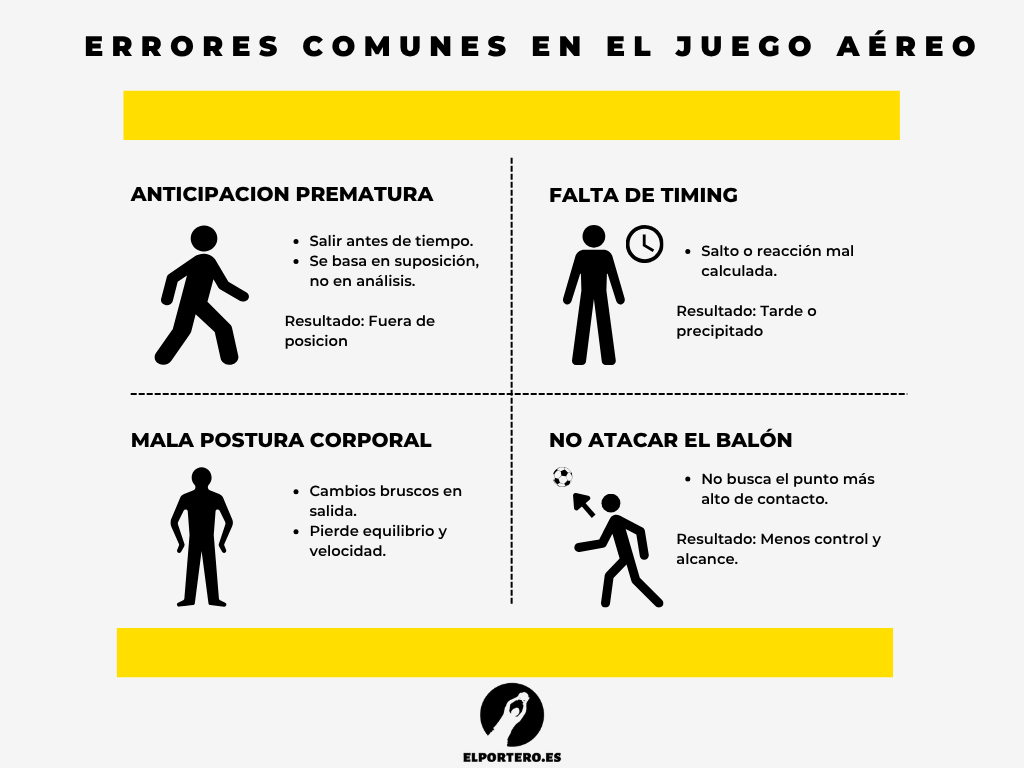
- Premature anticipation when moving out: One of the most common mistakes is when the goalkeeper decides to move out prematurely. This usually occurs when the goalkeeper tries to predict, rather than analyze, where the ball will go. This premature anticipation can lead to poor decision-making, leaving the goalkeeper out of position if the ball doesn't follow the expected path. A good goalkeeper must wait for the right moment to move out, based on the information they gain from observing the taker and the ball's trajectory.
- Lack of timing: Timing is essential in any sporting action, and especially in aerial play. A goalkeeper must have the ability to calculate the exact moment to come out and jump to intercept the ball. This includes recognizing when it's the right time to step onto the ball and when it's necessary to adjust their position. Failure to do so correctly can result in a hasty exit or, conversely, a delayed reaction.
- Improper Change in Body Posture: A goalkeeper's body posture is crucial to maximizing their ability to move quickly in any direction. However, when a goalkeeper changes their posture at the moment of a goal kick, they can lose efficiency in their movement. Sometimes, a sudden change in body orientation at the moment of the ball being kicked reduces their ability to react. The goalkeeper must have a balanced and flexible posture that allows them to move quickly in any direction without losing stability.
- Not attacking the ball: A very common mistake is not attacking the ball properly. Instead of directing its trajectory toward the highest point of the play, the goalkeeper may take a trajectory that doesn't take him to the highest point of the ball, which decreases the chances of successfully intercepting it. Attacking the ball means going at it with determination, taking advantage of maximum jumping range and control of the situation.
The 4 key steps to success in the aerial game
To increase the chances of success in aerial plays, it's essential to follow an orderly and precise process. These steps not only help you stay calm in pressure situations but also optimize the chances of a successful intervention. Below are the four essential steps for successfully clearing an aerial ball.
Step 1: Observe
The first, and probably most crucial, step is to observe the ball. This seems obvious, but many goalkeepers don't focus enough on accurate observation from the moment the ball leaves the kicker's foot. It's vital to follow the ball's trajectory at all times, from its departure to its arrival. In addition to seeing the ball, it's also important to observe the kicker and their posture to detect any possible clues about the ball's direction, whether through the way they strike it or the technique they use.
Observing all of this will give us the information we need to more accurately analyze how the ball will move through the air and whether there is any chance of intercepting it.
Step 2: Analyze
Once the ball has been struck and is in the air, it's time to analyze its trajectory, speed, direction, and height. The goalkeeper must be able to identify the force with which the ball was thrown, as well as the angle at which it travels. This is where game reading and decision-making skills come into play. A correct analysis of the situation will allow the goalkeeper to more accurately determine whether they have a chance to reach the ball, how difficult the jump will be, or whether their positioning needs to be adjusted.
At this stage, the behavior of opposing players must also be taken into account, as they can interfere with the ball's trajectory or make it difficult to intervene. The analysis therefore includes the context of the entire play.
Step 3: Decide
Once the goalkeeper has observed and analyzed the ball's trajectory, it's time to decide. Decision-making is essential to determine what action to take: whether to go for the ball, stay in goal, or attempt a different type of intervention. This is the moment when the probabilities of success are assessed.
- If the goalkeeper has a high probability of success and is able to safely reach the ball, they must decide how to approach the play. This involves taking the correct steps toward the ball, adjusting their posture and technique to jump efficiently, and attacking the ball with the greatest possible determination and confidence.
- If the goalkeeper doesn't have a high probability of success (for example, if the ball's trajectory is too far away or there is doubt about the impact of the shot), the best option may be to stay in goal and remain alert for any subsequent shots that may occur. In this step, it is crucial that the goalkeeper not be driven by desperation or the fear of not trying to intervene. The decision should always be based on a rational analysis of the probabilities of success.
Step 4: Execute
The final step is execution. This means executing the action precisely and decisively. Once the goalkeeper has decided to go for the ball, he or she must do so with complete confidence. The exit must be energetic and controlled, with the confidence that the best decision has been made based on the previously analyzed situation.
The goalkeeper must come off his line with authority, ensuring he doesn't waste time or distance on the ball. Furthermore, the exit must be made with sufficient force to ensure the ball can be intercepted without risk of injury or being overtaken by other players.
Conclusion
Aerial play is an essential component of a goalkeeper's repertoire, and mastering it requires practice, patience, and concentration. Common mistakes can be easily avoided by following the correct steps: observe, analyze, decide, and execute. By understanding the importance of each phase and how to apply them efficiently, a goalkeeper will not only improve in the air but will also gain more confidence in their ability to handle high-pressure situations.
The goalkeeper must observe the ball and the kicker's posture to anticipate the direction of the shot and decide how to intercept it.
The goalkeeper must analyze the trajectory, speed, and height of the ball, along with the context of the game, to decide how to intercept it and adjust his position if necessary.
The goalkeeper must execute his decision with confidence and force, ensuring an energetic and controlled exit to intercept the ball without errors or risks.
Don't forget that success in the air isn't just a matter of physical skill, but also of excellent decision-making at the right time. If you want to further perfect your technique, we invite you to read our Complete Guide: Aerial Game in Goalkeeping.
Keep practicing, and fly high on every play!
 English
  Spanish
Parabéns !
Vejo ainda que componentes como:
– a percepção espacial;
– o domínio e controle espaço-temporal;
– a capacidade de recuperação e;
– a definição clara das atribuições táticas dos goleiros.
Irão proporcionar boas condições para as saídas em cruzamentos altos sobre as áreas de meta.
Rommel Araujo
Este é Rommel Araújo.
Os componentes que você diz caberiam muito bem em algumas partes da publicação, mas foi feita uma tentativa de fazer uma visão mais global, com a intenção de não tornar a publicação excessivamente longa.
Obrigado pelo seu comentário e pela sua contribuição. Saudações