📅 Publicado el: December 9, 2024
🔄 Última actualización: August 3, 2025
Ladder Coordination Exercise Guide: 25 Ideas for Goalkeepers
Coordination is one of the most crucial skills in the development of a modern goalkeeper. Far from being a mere accessory, it has become a fundamental pillar of specific training, especially during the formative stages. In this context, the use of coordination ladders is presented as a versatile, effective, and accessible tool for developing this ability in a progressive and structured manner.
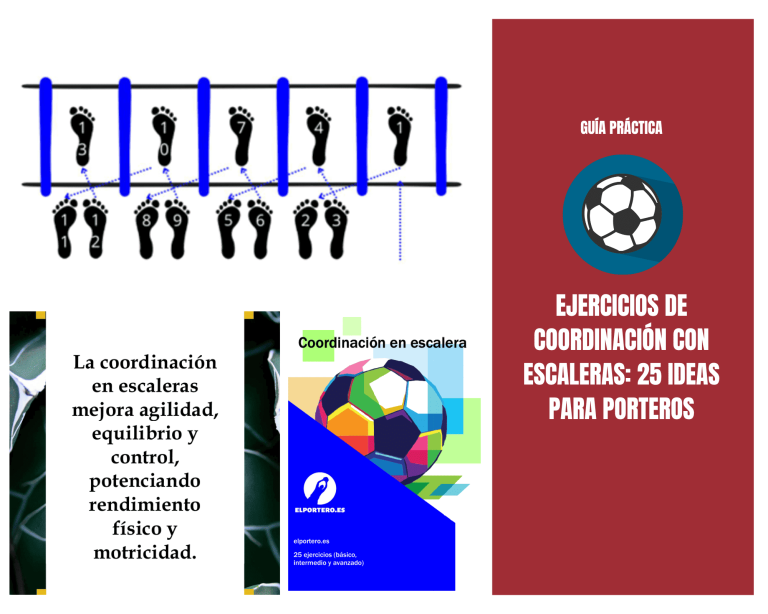
In this article, we present our Guide to Coordination Exercises with Ladders, a practical collection of 25 exercises organized by level (basic, intermediate, and advanced) to help you plan dynamic and effective sessions. Available in Spanish and English, this guide has been designed for goalkeepers of all ages and levels, with the aim of facilitating coordination work from an evolutionary and adaptable perspective.
Why is coordination so important for goalkeepers?
Coordination is the ability to perform effective, precise, and controlled movements, especially in situations requiring reaction speed, changes of direction, and synchronization between limbs. For a goalkeeper, this skill is critical, as it directly affects their ability to make saves, blocks, lateral movements, drives, and clearances in high-pressure situations.
A well-coordinated goalkeeper not only reacts faster, but also moves with more efficiency and economy of gestures. This translates into greater performance, a lower risk of injury, and better adaptation to the different phases of the game. To delve deeper into the role of coordination in goalkeeper development, we recommend reading The role of coordination in goalkeeper development.
Coordination ladders: a key tool
Coordination ladders allow for the development of multiple aspects of a goalkeeper's physical and technical work, including:
- Rhythm and timing
- Dissociation of movements
- Balance and stability
- Reaction and decision-making in motion
Plus, they're easy to transport, can be used on any surface, and are suitable for all types of sessions, from dynamic warm-ups to specific technical workouts.
Adapting coordination during growth: a priority
One of the most common mistakes in training young goalkeepers is not adapting coordination work to their growth stages. The body changes rapidly during adolescence: segments lengthen, the center of gravity shifts, and temporary imbalances between limbs develop. If coordination is not specifically and progressively worked on, the goalkeeper can develop awkward movements, lose motor efficiency, and even develop insecurities in their game.
That's why it's essential to understand the key stages in goalkeeper training and adapt the coordination exercises according to the evolutionary stage of each player. At an early age, the objective should not be the perfection of movement, but rather exploration, motor learning and the basis for future specializations.
The Guide: 25 Exercises to Take Everywhere
Our Ladder Coordination Exercise Guide has been designed to be an easy-to-use and practical resource. You can download it for free, save it on your phone or tablet, or print it to use during your workouts. It's available in Spanish and English and is divided into three levels:

- Essential
Exercises to begin learning the coordination ladder, improving rhythm, spatial orientation, and basic footwork. Perfect for young goalkeepers or those new to this type of work.
- Intermediate
More complex movements that require greater dissociation, postural control, and motor decision-making. Here, the goalkeeper must already have a certain coordination base.
- Advanced
Dynamic exercises that integrate changes of direction, crossover movements, and specific goalkeeping work. A good technical and physical level is required.
It's important to note that the categorization is general: what may be a basic exercise for one goalkeeper may be a real challenge for another. Therefore, it's essential to consider the individual coordination level and adapt the workout to each goalkeeper's needs.
Download the Free Guide in Spanish and English now
Click here to get your guide in PDF format:
👉 Descargar Guía de ejercicios de coordinación con escaleras en Español.
👉 Descargar Guía de ejercicios de coordinación con escaleras en Inglés.
Speed is trained, but with meaning
One of the most important (and often overlooked) aspects of coordination work is the progression of speed. Many coaches make the mistake of demanding maximum speed from the outset, which leads to uncontrolled movements, erroneous executions, and poor transferability to the real game.
The key is to prioritize correct technical execution at low speed, and once the gesture is mastered, gradually increase the pace. This is the only way to ensure solid and functional coordination. This principle is also fundamental to a goalkeeper's physical development, as explained in our article on physical aspects to work on with young goalkeepers.
Conclusion: An essential resource for coaches and goalkeepers
Coordination isn't an "extra," but a cornerstone of goalkeeper training. Working on it properly, from an early age and with structured planning, makes a clear difference in a player's performance, agility, and confidence between the sticks.
The Ladder Coordination Exercise Guide is a resource designed to support you in this process. With its 25 level-based exercises, its bilingual format, and its adaptive approach, it's ideal for both coaches and goalkeepers who want to improve their skills in a practical and effective way.
 English
  Spanish