
📅 Publicado el: December 30, 2024
🔄 Última actualización: August 3, 2025
Goalkeeper Analysis: A Comprehensive Approach Beyond the Goal
When we talk about goalkeeper analysis in soccer, we tend to focus solely on goals conceded or spectacular saves. However, understanding how to evaluate a goalkeeper requires digging much deeper: into their decision-making, their defensive communication, and their overall impact on the team's play.

Why isn't counting goals enough in a goalkeeper's technical analysis?
Measuring a goalkeeper solely by goals conceded is one of the common goalkeeping mistakes. A goalkeeper can concede unstoppable goals or barely participate in a match without truly showing his level.
For a more complete technical analysis of the goalkeeper, consider:
- Decision making under pressure.
- Body positioning before each action.
- Influence on defensive organization.
- Contribution to the ball output thanks to his footwork.
Each of these aspects determines your true contribution to the team, beyond visible statistics.
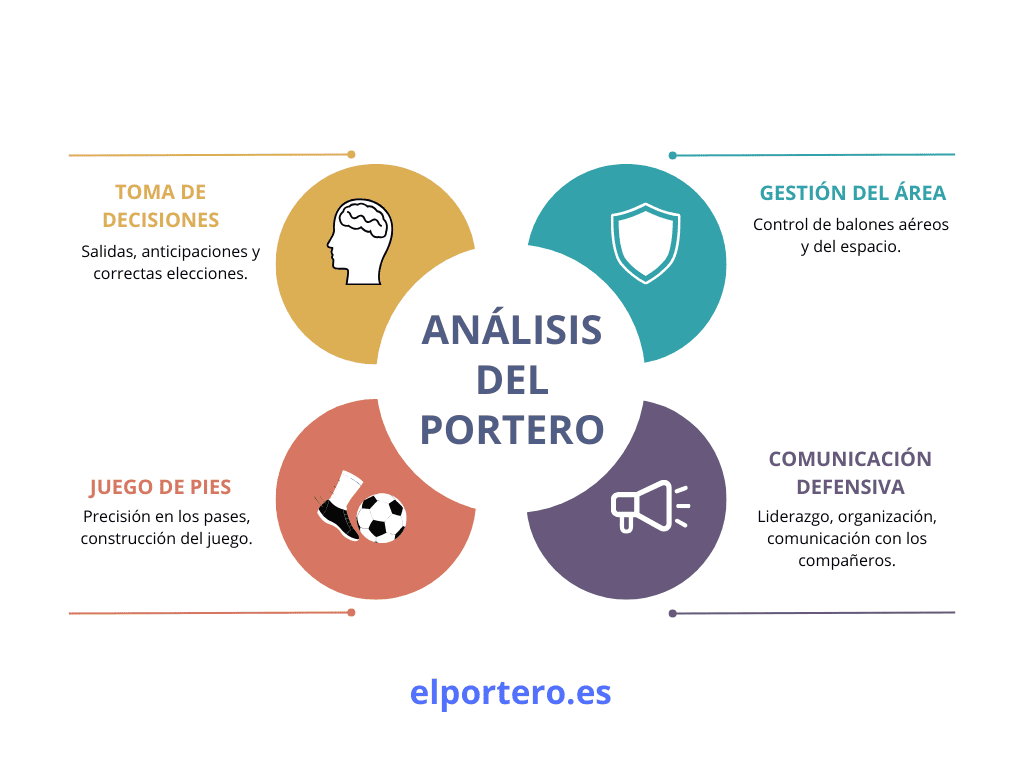
Goalkeeper decision-making: a key factor in performance
One of the pillars of a modern goalkeeper's performance is his ability to make quick and accurate decisions in dangerous situations.
Practical example:
Situation: An aerial ball lands near the edge of the area in a quick transition by the opponent.
The goalkeeper must decide:
- Going out to intercept the ball at risk?
- Waiting under the sticks anticipating the shot?
- Coordinate with the defense to close spaces?
This goalkeeper decision-making can define a play and, in many cases, the outcome of a match.

The importance of footwork in the modern goalkeeper
The goalkeeper's footwork has ceased to be an accessory and has become a necessity. Today, a goalkeeper actively participates in the offensive buildup.
Key aspects in this analysis:
- Accuracy in passes under pressure.
- Ability to break opponent pressure lines.
- Interpretation of the pace of play (speed up or pause).
A good goalkeeper should be the first playmaker, initiating reliable attacks from his own penalty area. For a deeper look into this topic, you can read the article The goalkeeper and playing with the foot.
Area management: spatial dominance as a competitive advantage
Among the key aspects of a goalkeeper's performance, goalkeeper control and space management are essential.
An effective analysis should observe:
- Safety when going out on aerial balls.
- Comfort zone control.
- Synchronization with the defensive line.
It's not enough to just make good saves: it's about anticipating risks and neutralizing threats before they materialize. To delve deeper into this topic, you can read The goalkeeper and space/time: anticipation and positioning.
Defensive Communication: The Goalkeeper's Invisible Leadership
Effective defensive communication in soccer turns the goalkeeper into the silent leader of the team. Not only does he protect his own goal, but he also organizes and provides security to the defensive unit.
Observable aspects:
- Clear instructions to colleagues.
- Verbal anticipation of possible risks.
- Ability to correct positions and strengthen the defensive structure.
A goalkeeper with a voice and leadership is a strategic asset for any team. To learn more about this, you can read What does a goalkeeper really do throughout the entire match?.
Checklist for analyzing a goalkeeper's performance
To perform a complete and objective analysis, use this list:
- How is your positioning in different phases of the game?
- What decisions do you make in rapid transitions?
- What is your success rate in footwork?
- Do you dominate the area when faced with divided balls?
- Is your defensive communication consistent and effective?
- How do you react after making mistakes?
- Do you stay focused during games with little activity?
This checklist will help you understand how to professionally analyze a goalkeeper's performance.
Conclusion: Look beyond the goals in goalkeeper analysis
In today's football, analyzing a goalkeeper requires looking beyond the number of goals conceded. Their real impact is built on small actions: decision-making under pressure, space control, playmaking, and leadership.
If you want to develop or identify the ideal goalkeeper, start evaluating these invisible but crucial details. Remember: a great goalkeeper doesn't just save goals, he saves games.
 English
  Spanish