
📅 Publicado el: August 12, 2025
🔄 Última actualización: August 12, 2025
How to convince a goalkeeper that making mistakes is the first step toward success
In a goalkeeper's development, especially during their early stages of learning, it's crucial to change their perception of mistakes. Young goalkeepers are not only learning the technical aspects of their position, but also developing a strategic understanding of the game from the goal line. However, one of the biggest obstacles in this process is the fear of making mistakes, a barrier that can slow their progress.
The fear of error: a brake on growth
Many goalkeeping coaches face a common situation: young players who avoid certain moves or decisions for fear of making a mistake. This fear is often fueled by criticism, both from their peers and coaches. It's important to understand that, in the formative stages, children are not professionals; they are apprentices, and are in the midst of a discovery process.
Error, far from being a problem, is one of the most important pillars of learning. In fact, avoiding failure limits exploration, reduces self-confidence, and prevents the development of critical skills. Therefore, it is the coach's responsibility to reframe error as an opportunity for improvement, a tool for progress.
To delve deeper into how mistakes drive learning and continuous improvement in goalkeeping, you can read this complementary article: Mistakes are fundamental to a goalkeeper's learning process.
The role of the coach: from judge to guide
As coaches, we must take on a key role: creating an environment where goalkeepers feel comfortable making mistakes and learning from them. This doesn't mean encouraging negligence, but rather normalizing failure as a necessary step on the path to success.
In training, we should encourage goalkeepers to try, experiment, and take risks. Especially in controlled contexts, such as specific exercises, mistakes should be viewed as a learning resource rather than a failure. It is essential to accompany this process with questions and reflections that allow the goalkeeper to understand what they did wrong and why. This way, not only is a specific movement or decision corrected, but conscious and lasting learning is developed.
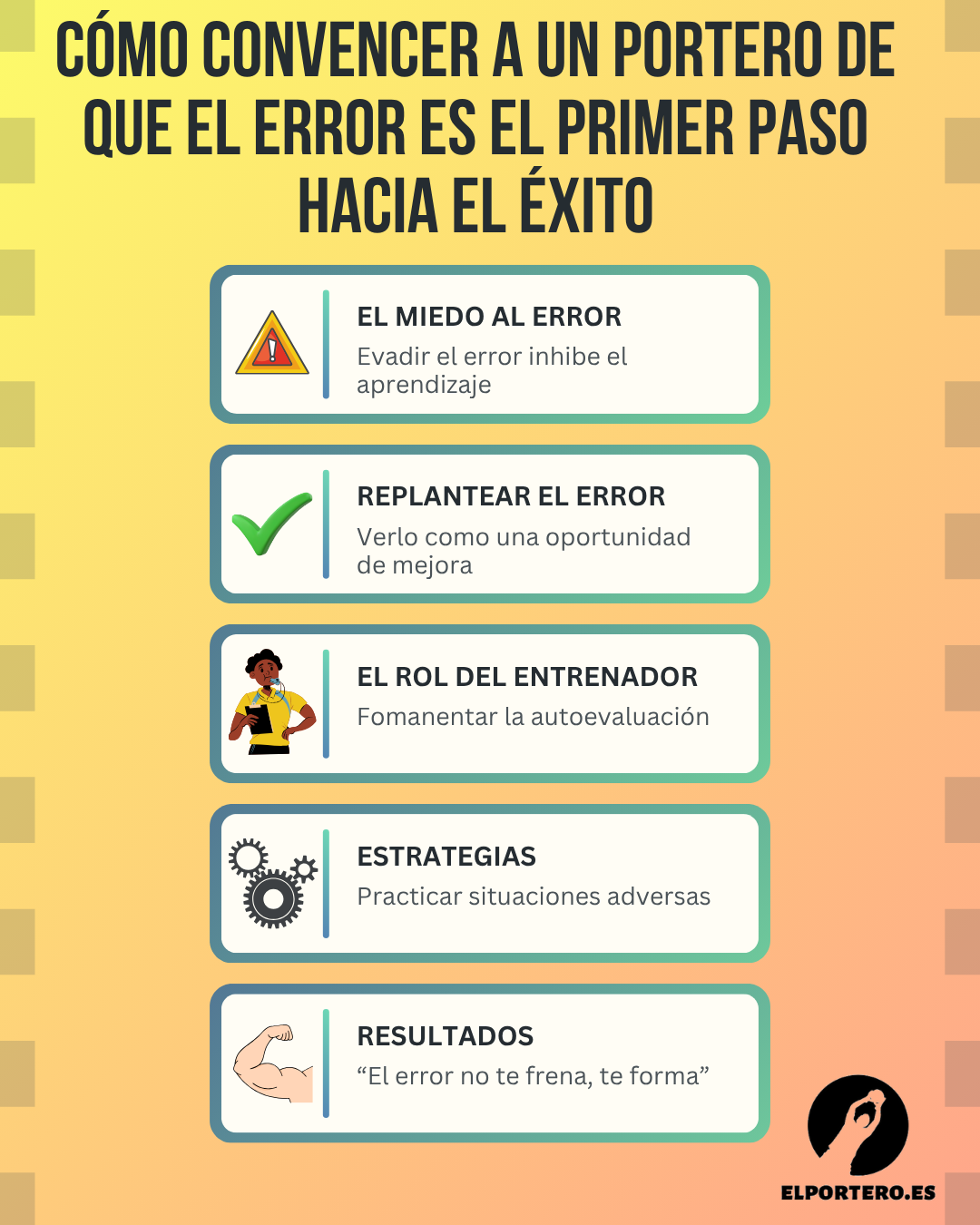
Strategies for working on errors in training
To make the most of errors as a learning tool, it is key to implement specific dynamics in training:
- Individual and guided reflection
After each exercise in which a goalkeeper has made a mistake, ask him:- What do you think you did wrong?
- What could you do differently next time?
These questions invite the goalkeeper to analyze their performance and take responsibility for their learning. This process of constructive self-criticism strengthens their confidence and problem-solving skills.
- Group dialogue
Sharing mistakes with the entire goalkeeping group encourages collective learning. For example:- Ask the group: “Why do you think that mistake was made?”
- Explain together how it can be corrected and what alternatives there are to avoid it in the future.
This approach has several benefits:
- It helps goalkeepers understand that mistakes aren't unique to one person, but rather common situations that can affect anyone.
- Strengthens attention and critical analysis during training.
- Create a collaborative environment instead of a competitive and critical one.
- Encourage technical courage
In training, goalkeepers should be encouraged to try techniques or movements they find difficult, even if they know they might fail. It's better to make mistakes in a controlled environment where they can be corrected with the coach's support than to avoid those movements for fear of failure in a real match.
Error as the basis of success
When a goalkeeper understands that making mistakes is a natural part of the process, they begin to approach training and matches with a more open and confident mindset. This shift in perspective not only allows them to improve technically, but also strengthens their emotional resilience, which is essential for a role as demanding as that of goalkeeper.
A key aspect of this process is for the goalkeeper to not only recognize their mistakes, but also be aware of their causes and know how to address them. The combination of self-awareness and technical support allows for consistent and significant improvement.
The role of the coach: patience and perseverance
For the goalkeeper to adopt this mentality, the coach must be a constant ally. This involves:
- Avoid destructive criticism that generates fear or insecurity.
- Focus corrections in a constructive and didactic manner.
- Celebrate the small steps forward after overcoming mistakes.
Conclusion
Mistakes are an inevitable, yet profoundly valuable, part of any goalkeeper's development. Convincing them that making mistakes is not only normal, but also desirable, during learning is a fundamental task for coaches.
A goalkeeper who understands mistakes as a tool, not an enemy, develops a stronger and more flexible mindset. Ultimately, what separates great goalkeepers from the rest isn't the absence of mistakes, but their ability to learn from them and continue to grow. As coaches, fostering this approach will not only help them improve on the field, but will also equip them with skills they can apply to all aspects of their lives.
 English
  Spanish