
📅 Publicado el: September 5, 2025
🔄 Última actualización: September 5, 2025
When should goalkeepers in training start strength training?
Strength training in grassroots football has gained significant importance in recent years, especially for goalkeepers in training. Strength is a key physical ability that directly influences a goalkeeper's performance, but its training must be adapted to each stage of a young player's development.
The question often arises: When is the right time to start working on strength in goalkeepers? The answer is simple: from an early age, as long as biological maturation is respected and the appropriate methods are used.
In this article, we discuss how and when to start developing strength in young goalkeepers, dividing the process into three main stages: junior, cadet, and youth. The goal is not only to improve performance, but also to prevent injuries and develop well-rounded goalkeepers in the long term.
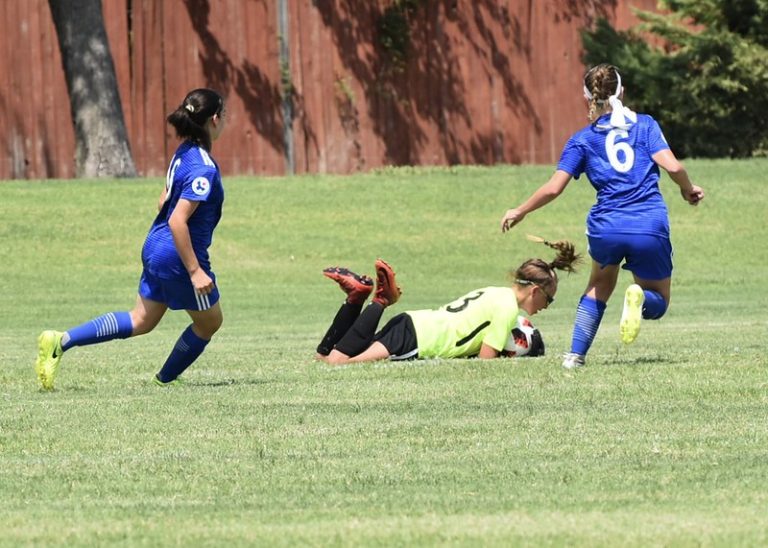
Why is it important to work on strength in young goalkeepers?
Goalkeepers need strength to perform a variety of decisive actions: jumping, clearing, tackling, tackling, blocking, changing direction, and more. While many of these skills rely on technique and decision-making, a good foundation of strength improves the execution of all of these moves and protects the body from injury.
To understand in depth the role of strength in this demanding position, you can read our post on strength in the soccer goalkeeper, which details how this ability influences each specific action of the game.
At a young age, strength training should be progressive, safe, and adapted to the goalkeeper's growth, prioritizing correct movement execution over the use of weights or increasing muscle mass.
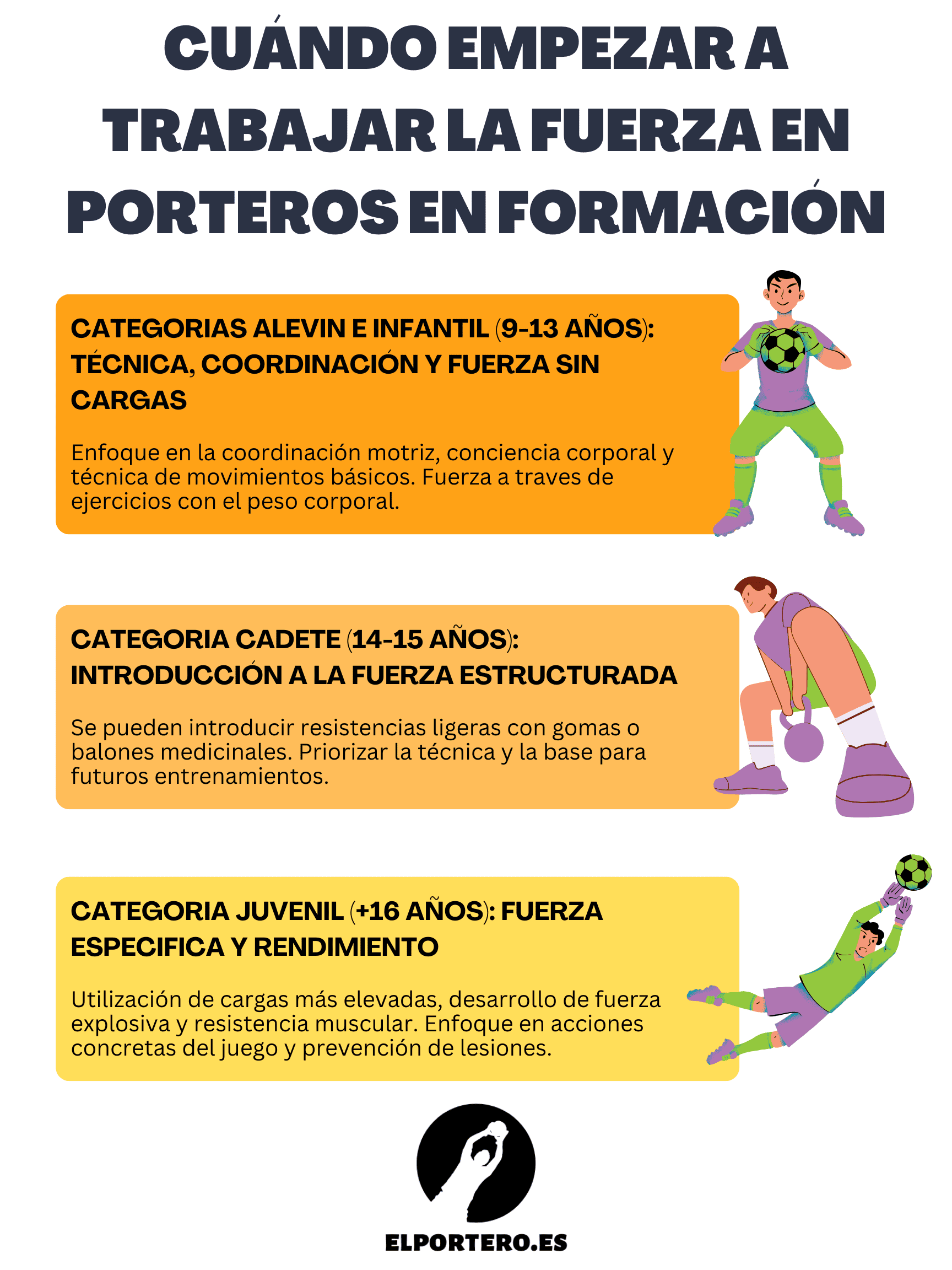
Alevín and Infantil Categories (9–13 years): Technique, coordination and strength without weights
During this stage, which spans from ages 9 to 13, goalkeepers are in a active growth phase, where their neuromuscular system is fully developing. Therefore, strength should be worked on, but in a specific way that is appropriate for their development.
The focus should be on:
- Improve motor coordination
- Develop body awareness
- Teach the technique of basic movements
- Introduce strength training through bodyweight exercises
This type of training helps prepare the goalkeeper for more demanding stages in the future, while having fun and learning key functional skills.
Recommended exercises:
- Controlled drop jumps
- Push and pull games for couples
- Race with changes of direction
- Stabilizations (plank, bridge)
- Dynamic supports on all fours or crawls
Strength is not trained here with external loads, but through the body itself and in a playful way. The goal is not to gain muscle, but to learn to move well.
It is also crucial to know how to manage the load during training at this stage, to avoid overtraining and promote healthy development.
Cadet Category (14–15 years): Introduction to the structured force
At this stage, many goalkeepers already show greater physical maturity and are ready to take a qualitative leap in their training. More structured strength training can be started here, as long as certain principles are followed:
- Introduction of light resistance (rubber bands, medicine balls, small weights)
- Continue prioritizing the execution technique
- Establish a solid foundation for future strength-specific training
This is a key moment to consolidate movement patterns, prevent muscle imbalances, and work individually according to each goalkeeper's level.
Suggested exercises:
- Squats with a medicine ball or rubber bands
- Lunges with postural control
- Basic plyometrics (jumps with good landing technique)
- Core stabilization in movement
- Compensatory work for shoulders and lower back
Youth Category (+16 years): Specific strength and performance
From the age of 16, goalkeepers have developed enough physical and technical foundation to incorporate specific, performance-oriented strength training. Higher loads can be used here, provided the goalkeeper's technique and level allow it.
The main objectives are:
- Develop explosive strength
- Improve muscle endurance
- Increase power in actions such as jumping, clearing, or blocking
- Apply preventive and compensatory work to avoid injuries
Training should be individualized, planned, and focused on the goalkeeper's specific needs based on their playing style and morphology.
To complement this approach, we recommend reading our article on the importance of goalkeeper power in football, where we delve into how to develop this ability from basic strength.
Common mistakes when training strength in young goalkeepers
- Using loads too soon: Can cause injuries and affect development.
- Neglecting technique: Execution is more important than load.
- Lack of progression: Skipping stages can stagnate development.
- Seek hypertrophy at an early age: This is not the goal for goalkeepers in training.
- Do not individualize the work: Each goalkeeper has a different maturation rate.
Conclusion: yes by force, but with planning
Strength training for young goalkeepers is key to their physical, technical, and preventative development, but it must be done progressively, planned, and adapted to their age and level. From the youth and youth categories, strength training without weights can begin, prioritizing movement learning. As the goalkeeper grows and matures, resistance training, more specific exercises, and performance-oriented routines are introduced.
The secret isn't just in when to start, but in how strength training is done at each stage. With a good foundation, goalkeepers can develop their full physical potential safely and efficiently.
 English
  Spanish