
📅 Publicado el: October 26, 2025
🔄 Última actualización: October 26, 2025
La visión espacial en el portero de fútbol: la clave invisible del rendimiento
In modern football, the goalkeeper's role has evolved dramatically. It's no longer just about stopping shots or coming in for aerial balls; now, the goalkeeper is a key player in playmaking, defensive organization, and tactical understanding of the match. However, there is a less visible, but absolutely crucial, quality that sets great goalkeepers apart from the rest: spatial vision.
This concept, although it may seem abstract, is what allows the goalkeeper to anticipate, position himself correctly, and react accurately to actions that occur in milliseconds. In a sport as fast-paced and ever-changing as soccer, mastering spatial vision can make the difference between a life-saving save and a preventable goal.
In fact, some analyses delve even deeper into this relationship between the goalkeeper and the notion of space-time, as explained in this interesting article, which addresses how the perception of the environment directly influences the goalkeeper's decisions and reflexes.
What is spatial vision in a soccer goalkeeper?
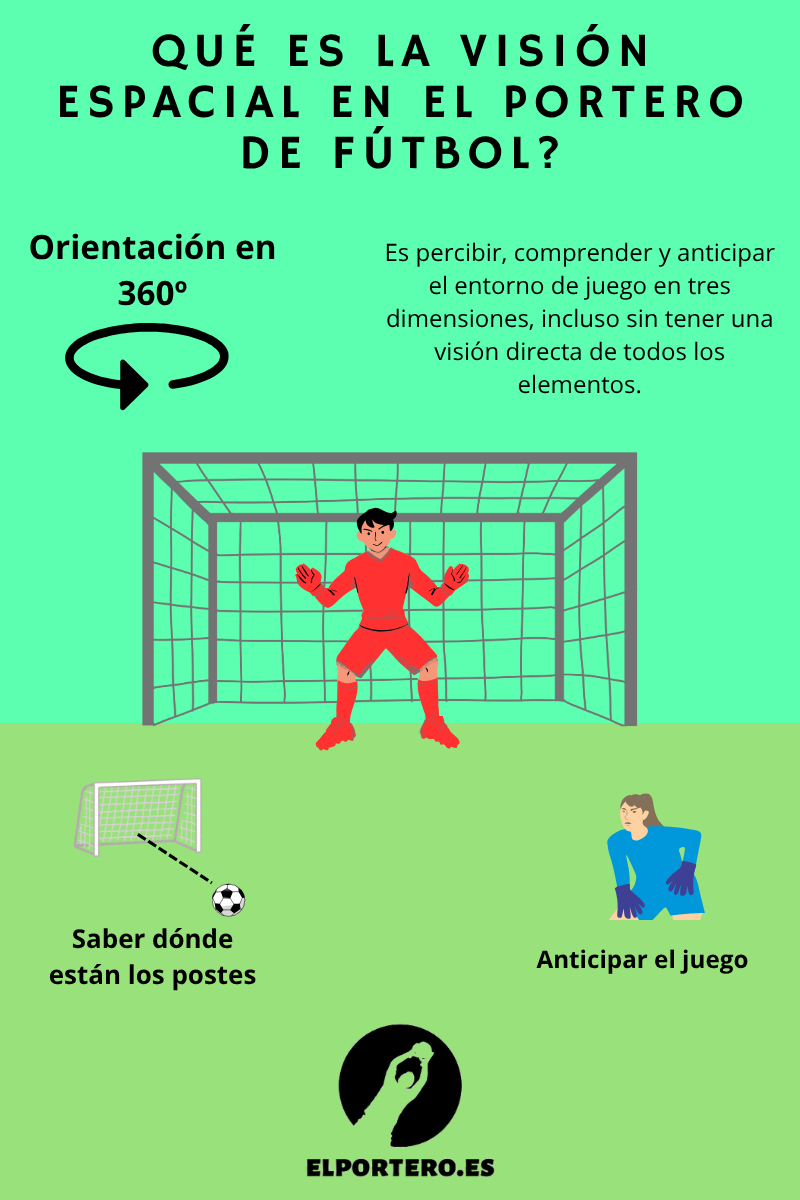
Spatial vision in soccer goalkeepers is the ability to perceive, understand, and anticipate the game environment in three dimensions, even without direct vision. In other words, it is the ability to orient oneself in space and maintain constant awareness of what is happening around them, both inside and outside their field of vision.
Although our eyes have a limited field of vision, great goalkeepers develop a true 360º orientation thanks to their perception, experience, and reading of the game. This “total vision” is not based only on what they see, but on what they perceive and predict: the position of the ball, their teammates, their opponents, and their own posts.
From a practical point of view, this ability translates into knowing where the posts are without looking at them, how far away they are from the ball, how their defenders are positioned, and what type of movement they need to make to correctly reposition themselves after each action. It is a perceptual-motor skill that involves attention, visual memory, anticipation, and body orientation.
This spatial vision is developed through practice, experience, and specific training aimed at improving game reading, body control, and decision-making. It's not just about seeing, but about interpreting space and acting accordingly.
A goalkeeper who masters this skill conveys confidence and control, both to themselves and to the team. They know when to come out, when to wait, how to position themselves to reduce the shooting angle, and how to orient their body to always have a clear reference to the goal. In short, spatial vision is the invisible compass that guides the goalkeeper's every move.
Examples where the goalkeeper needs excellent spatial vision
Spatial vision is present in every goalkeeper's actions, although it often goes unnoticed. Below are specific examples where this skill is crucial:
- Positioning in the arch
Positioning is the foundation of everything. A goalkeeper with good spatial vision knows at all times where the posts are without having to look at them. This allows them to position themselves correctly in front of the ball, cover the optimal angle, and reduce the surface area visible to the attacker.
This constant reference to the goal is trained with orientation exercises, lateral movements, and shot simulations, where the goalkeeper must respond without looking directly at the posts.
- The air actions
In crosses or aerial plays, spatial vision is essential. The goalkeeper must calculate the trajectory, speed, and landing point of the ball, while also being aware of the position of opponents and teammates in the area.
Without this three-dimensional perception, the risk of being misplaced or making a mistake when starting is very high. A goalkeeper with good spatial vision adjusts his position automatically, always maintaining a balance between the ball, the goal, and the impact area.
- Transitions and the start of the game
When the goalkeeper initiates play—whether with his foot or his hand—he also needs a comprehensive view of the field. He must visualize the open space, interpret the opponent's pressure, and choose the best passing option.
Here, spatial vision is combined with quick decision-making and tactical reading. This allows, for example, to quickly pass to a free throw-in or break the lines with a pass aimed at the central midfielder.
- One-on-one situations
In a one-on-one, spatial vision allows the goalkeeper to calculate distances, close angles, and control the speed of the forward's approach. Although the visual focus is on the ball, the goalkeeper must take into account the entire context: the position of the posts, his own balance, and the possible direction of the shot.
- Defensive coverages
In modern football, the goalkeeper also acts as a defensive sweeper. He must read when to leave the penalty area to intercept a long ball or cover for his defenders. To do this, he needs precise spatial vision that allows him to assess the time and distance of the ball's arrival and that of the opponent.
Conclusion
Spatial vision is one of the most complex and decisive skills in a soccer goalkeeper's performance. It's not just about having good eyesight, but also about understanding space, anticipating movements, and controlling the environment even without seeing it directly.
Developing it requires training, body awareness, and constant practice in real-life game situations. A goalkeeper with spatial vision not only reacts, but also anticipates. And in a sport where details decide matches, this ability to perceive beyond the visible can be the difference between being a good goalkeeper and becoming an exceptional one.
 English
  Spanish