
📅 Publicado el: October 4, 2024
🔄 Última actualización: August 3, 2025
Goalkeeper strategies for stopping penalties

In the world of football, few situations generate as much tension as a penalty kick. It's a psychological and technical duel between the penalty taker and the goalkeeper, where, in theory, the attacker has the advantage. However, this apparent inequality can be leveled if the goalkeeper knows how to apply the right strategies. In this article, you'll discover how to increase your chances of saving penalties through analyzing your opponent, reading body language, and mental preparation.
Pitching Analysis: Information as a Defensive Weapon
One of the most effective ways to anticipate a penalty is to study the opposing team's penalty takers in advance. Statistical and visual analysis allows you to recognize patterns and trends that make the difference in decisive moments.
Use of videos and statistics
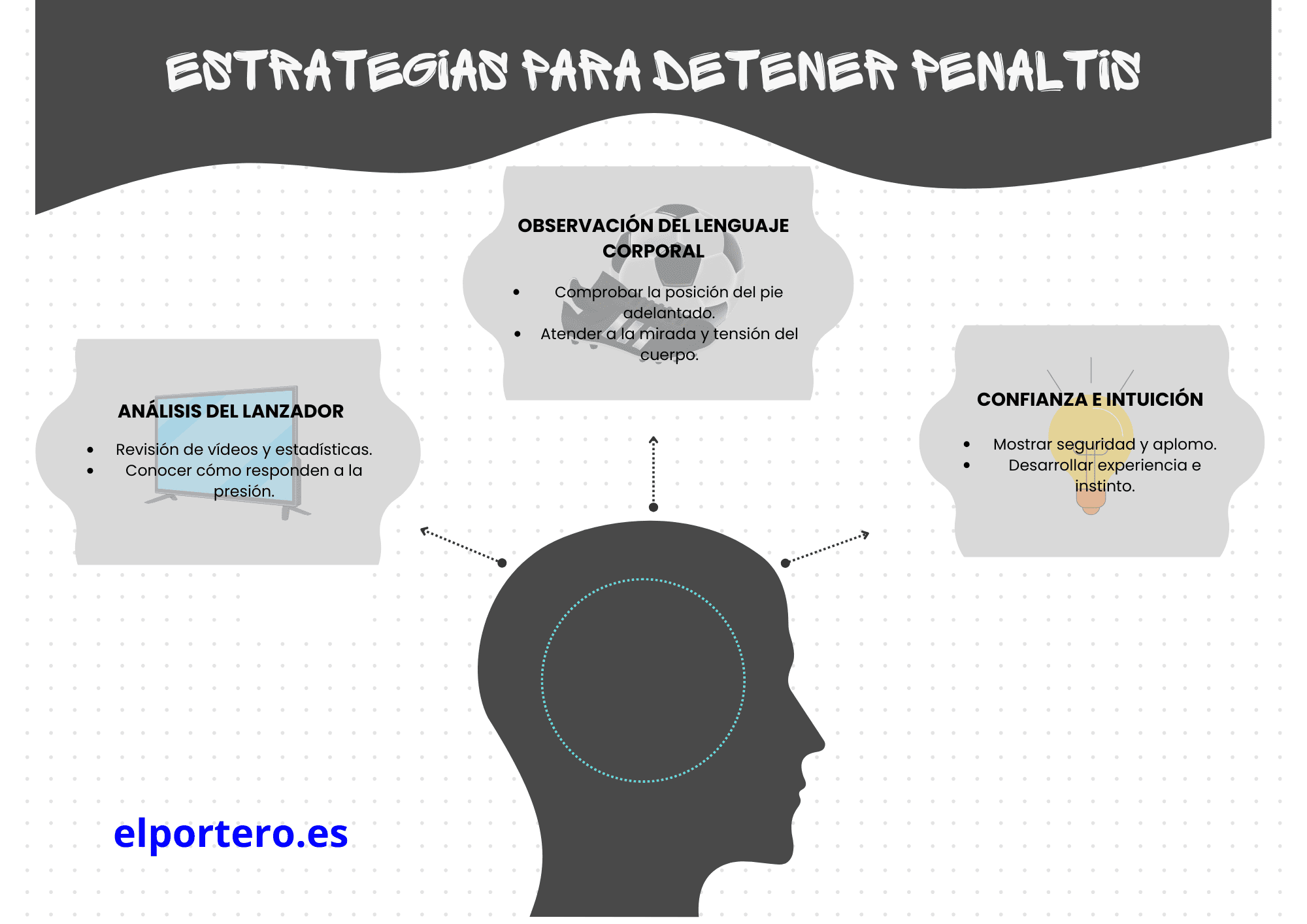
Thanks to video analysis, goalkeepers can observe the typical trajectory of shots, the shooter's preferred direction, or whether they prefer power over placement. Platforms like WyScout or Instat help gather useful data, especially in professional or semi-professional categories.
For example, if the forward tends to shoot to the left in 70% of penalties, this information can influence the goalkeeper's decision at the moment of the shot. In our article on how to analyze opposing teams' penalties, we delve into how to gather and apply this information, even in amateur football.
Pitcher Psychology: Knowing Your Mind
In addition to technique, it's crucial to understand how a player responds to pressure. Some takers display tendencies when they're nervous: they consistently repeat the same direction or avoid risky shots. An experienced goalkeeper can leverage these patterns to make strategic decisions.
Body Language Observation: Real-Time Keys
When there's no prior information about the opponent, the goalkeeper must rely on his observation skills during the shot. Some clues can reveal where the ball will go before the foot hits the ball.
The forward foot
One of the most revealing gestures is the position of the feet before shooting. Many players unconsciously place their supporting foot slightly forward toward the side they are shooting. Although not an absolute rule, this clue can be useful when combined with other elements.
Gaze direction and body tension
Other useful signs include the direction of the gaze at the last second, the angle of the trunk, or the relaxation of the shoulders. Some pitchers tend to look toward the area where they will throw just before the shot, while others subtly adjust their posture.
The key is to observe without anticipating things too much. A misread can be costly, but when this skill is honed, it becomes a powerful advantage.
Confidence and intuition: the goalkeeper's invisible weapons
Technique and tactics are essential, but in a penalty, the goalkeeper's mentality can be what tips the balance.
The importance of trust
Showing confidence and conviction is just as important as any prior analysis. A confident goalkeeper, who maintains composure and eye contact with the shooter, can generate doubt in the opponent. This uncertainty can lead to errors or less accurate shots.
This emotional component of the penalty is so strong that many coaches include visual intimidation techniques in their goalkeeper psychological training.
Intuition based on experience
Intuition isn't magic: it develops over time, through observing hundreds of shots, training under pressure, and facing diverse game situations. An experienced goalkeeper can "read" a play without needing detailed analysis. Often, that first hunch based on feelings turns out to be the right decision.
Practical tips to improve your penalty shootout
Here are some additional tips you can implement in your training and matches:
- Practice penalty kicks in specific sessions, simulating real-life pressure situations.
- Study the top pitchers in your league.
- Develop a personal routine to stay calm before shooting.
- Work on reaction time through speed and eye-hand coordination exercises.
- Visualize success scenarios before each penalty to strengthen your mindset.
Conclusion: the penalty as an opportunity, not as a condemnation
Even if the statistics say the penalty taker has the advantage, the penalty shouldn't be viewed as a penalty for the goalkeeper. With tactical preparation, keen observation, mental strength, and a little intuition, a goalkeeper can turn that critical moment into an opportunity to shine.
Adopting a proactive and strategic attitude transforms the usual narrative: the goalkeeper stops being the victim of the shot and becomes the protagonist of the save. And it is in that moment, when all seems lost, that the figure of the hero between the posts can emerge.
If you're interested in learning more about how to better prepare for these types of situations, you might find this article on how to analyze opposing teams' penalties useful: Guide to analyzing penalties in amateur football.
 English
  Spanish