
📅 Publicado el: October 31, 2025
🔄 Última actualización: October 31, 2025
How to simulate real match situations in your goalkeeper training sessions
In modern football, the goalkeeper's role has evolved from simply guarding the goalposts to becoming an integral part of the team's playing style. Their active participation in ball distribution, tactical awareness, and ability to resolve complex situations in tight spaces make them a key player.
Therefore, training must go far beyond isolated technical work. It is essential that the drills replicate the environment, speed, and demands of a real match. Simulating real match situations in training not only improves a goalkeeper's performance but also their adaptability, decision-making, and emotional management under pressure.
The importance of training under real match contexts
In modern football, preparing goalkeepers in contexts similar to those of competition is essential. Decontextualized training—focused solely on technical repetitions—does not guarantee a real transfer to the game. On the contrary, working in environments that recreate the intensity and unpredictability of a match enhances game reading, concentration, and reaction to changing stimuli.
The goalkeeping coach must be able to design drills that maintain the logic of the game, where each technical action is accompanied by a tactical decision and an emotional response. This makes learning more complete and effective.
Preliminary analysis: understanding the category and its competitive context
Before setting any task, it is essential to understand the competitive context in which the goalkeeper operates. Although football has universal principles, the characteristics of the different categories make significant differences in the type of actions that are repeated most frequently.
For example:
- In youth or amateur categories, shots from mid-range, 50/50 balls, and uncontrolled rebounds are common.
- At semi-professional or professional levels, winger actions, measured crosses, and finishes after inside combinations predominate.
Having this information allows the coach to tailor training to the specific realities of the competition, maximizing transfer and avoiding wasting time on unusual situations.
This guidance can be obtained through:
- Match analysis, observing patterns, danger zones, and offensive trends.
- The goalkeeping coach's own experience, providing a practical and contextual view of the most frequently repeated types of plays.
Task design and transfer to the actual game
Once the most common situations have been identified, the next step is to design tasks that reproduce them progressively and realistically.
The most common mistake is forcing artificial plays. Instead, the work should be gradual: start with the main technical action and progress to full simulation.
For example, when training second plays, you can start with a block or clearance, add an immediate second action (such as an opponent's shot attempt), and finish with reading the surroundings, including teammates and opponents in motion.
For these tasks to be truly effective, the coach must control several variables:
- Space: perform the action in the actual area of the field.
- Players: Include teammates and rivals to provide context.
- Rhythm: execute at the speed appropriate to the match.
- Decision: introduce uncertainty to encourage anticipation.
The more the training conditions resemble competitive reality, the greater the transfer to the goalkeeper's performance.
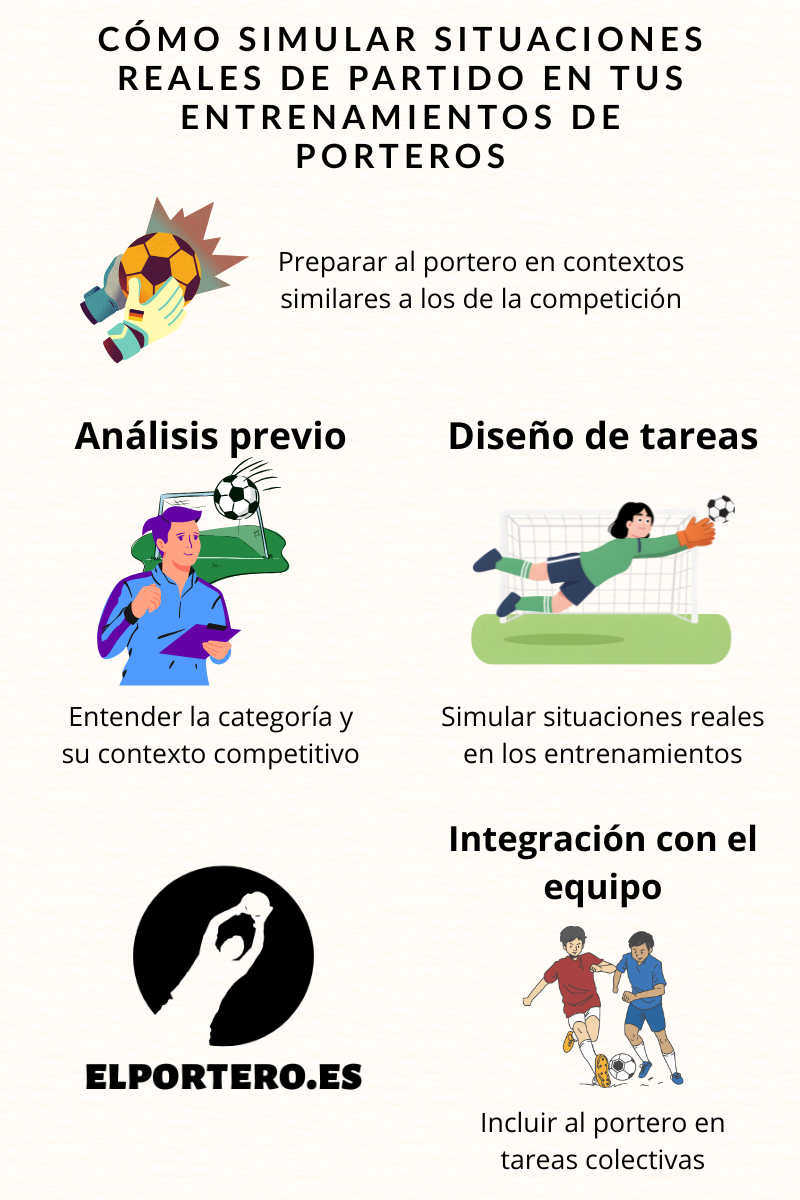
Integration with the team's collective work
Goalkeeper training should not be done in isolation. Including it in team drills improves their tactical understanding and coordination with the defensive line.
Some practical examples:
- In low block drills, you can train the handling of crosses by coordinating movements between the goalkeeper and the defenders.
- In offensive transition drills, the goalkeeper can work on initiating play with precision, simulating runs out after regaining possession.
This comprehensive approach strengthens communication, synchronization, and consistency with the team's game model.
Continuous evaluation and adaptation
Simulating real-life situations is not a static process. The coach must constantly evaluate the effectiveness of the drills and adjust their complexity based on the goalkeeper's progress.
Direct observation, the use of video, and immediate feedback are fundamental tools for verifying that exercises truly contribute to performance.
Furthermore, controlled variability—changing angles, rhythm, distance, or external conditions—maintains the goalkeeper's focus and stimulates their ability to adapt to any match context.
Conclusion
Simulating real match situations in training does not mean exactly copying what happens in competition, but rather creating progressive, realistic, and functional contexts that prepare the goalkeeper to act effectively in the face of unexpected events in the game.
A well-structured training program, based on observation, analysis, and methodological progression, will allow the goalkeeper to transfer their performance from the training field to the match with naturalness, confidence, and consistency.
Ultimately, training as you play is the key to developing goalkeepers capable of meeting the real demands of modern football.
 English
  Spanish