
📅 Publicado el: octubre 3, 2025
🔄 Última actualización: octubre 3, 2025
El core del portero: mucho más que abdominales
Cuando pensamos en la preparación física de un portero, solemos imaginar reflejos felinos, saltos espectaculares o manos firmes. Sin embargo, hay una parte del cuerpo que sostiene todo ese rendimiento y que muchas veces se entrena menos de lo necesario: el core.
El core no es solo la “tableta de abdominales” que todos visualizamos. Es el centro de estabilidad y potencia del portero, la zona que conecta el tren superior con el inferior y que garantiza equilibrio en cada blocaje, caída o salto. En este artículo vamos a descubrir por qué el core es vital para un portero de fútbol, qué beneficios aporta y cómo entrenarlo con ejercicios prácticos que puedes hacer en cualquier lugar.

¿Qué es el core y por qué es importante para un portero?
El término core hace referencia a la musculatura que rodea la zona media del cuerpo: abdominales, lumbares, glúteos, caderas y musculatura profunda que estabiliza la columna.
En un portero, el core cumple varias funciones clave:
- Estabilidad: cada vez que te lanzas a por un balón, necesitas un eje fuerte que mantenga el equilibrio al caer.
- Potencia: la fuerza de un salto o de una estirada parte del core, que transmite la energía de las piernas hacia el resto del cuerpo.
- Prevención de lesiones: un core fuerte protege la zona lumbar y la cadera, dos de las partes más castigadas en los porteros.
- Rapidez de reacción: al estabilizar el cuerpo, el core permite moverte con más agilidad en acciones cortas dentro del área.
En resumen: un portero sin un core bien trabajado está limitando su rendimiento y aumentando el riesgo de lesiones.
Si quieres profundizar más en cómo actúan los músculos en cada acción de la portería, te recomiendo leer este artículo sobre la técnica del portero y los músculos más activos.
Core vs. abdominales: la diferencia clave
Es un error común pensar que entrenar el core es lo mismo que hacer abdominales clásicos. Los típicos “crunch” o encogimientos trabajan principalmente la zona frontal, pero dejan de lado músculos fundamentales como los oblicuos, la zona lumbar o los músculos profundos de la pelvis.
En el fútbol —y más aún en la portería— los movimientos nunca son lineales. Saltas en diagonal, giras el tronco, te lanzas hacia un costado, te levantas rápidamente… Para eso necesitas un core tridimensional que funcione en todas las direcciones.
Beneficios de un core fuerte en el portero
- Mejora en el blocaje aéreo
Un tronco estable permite estirarte más y caer con mayor control, reduciendo el riesgo de golpearte mal al aterrizar. - Más potencia en los despejes y saques
Tanto en un saque de volea como en un despeje con el puño, la energía parte del core. Si la zona media es débil, perderás potencia en la acción. - Mayor seguridad en las caídas
El portero pasa gran parte del partido lanzándose al suelo. Un core sólido ayuda a amortiguar mejor los impactos. - Agilidad en los desplazamientos cortos
Los pasos laterales, tan frecuentes en la portería, requieren un centro de gravedad fuerte para ser rápidos y controlados. - Prevención de molestias lumbares
Muchos porteros sufren dolores de espalda por falta de fuerza en la zona media. Con un core fuerte, esa carga se reduce.
Aquí puedes leer más sobre las lesiones más comunes en porteros y cómo prevenirlas.
Ejercicios de core para porteros
Aquí te dejamos una rutina sencilla pero efectiva para fortalecer el core. Lo mejor es que no necesitas material, solo tu propio peso corporal y un poco de espacio.
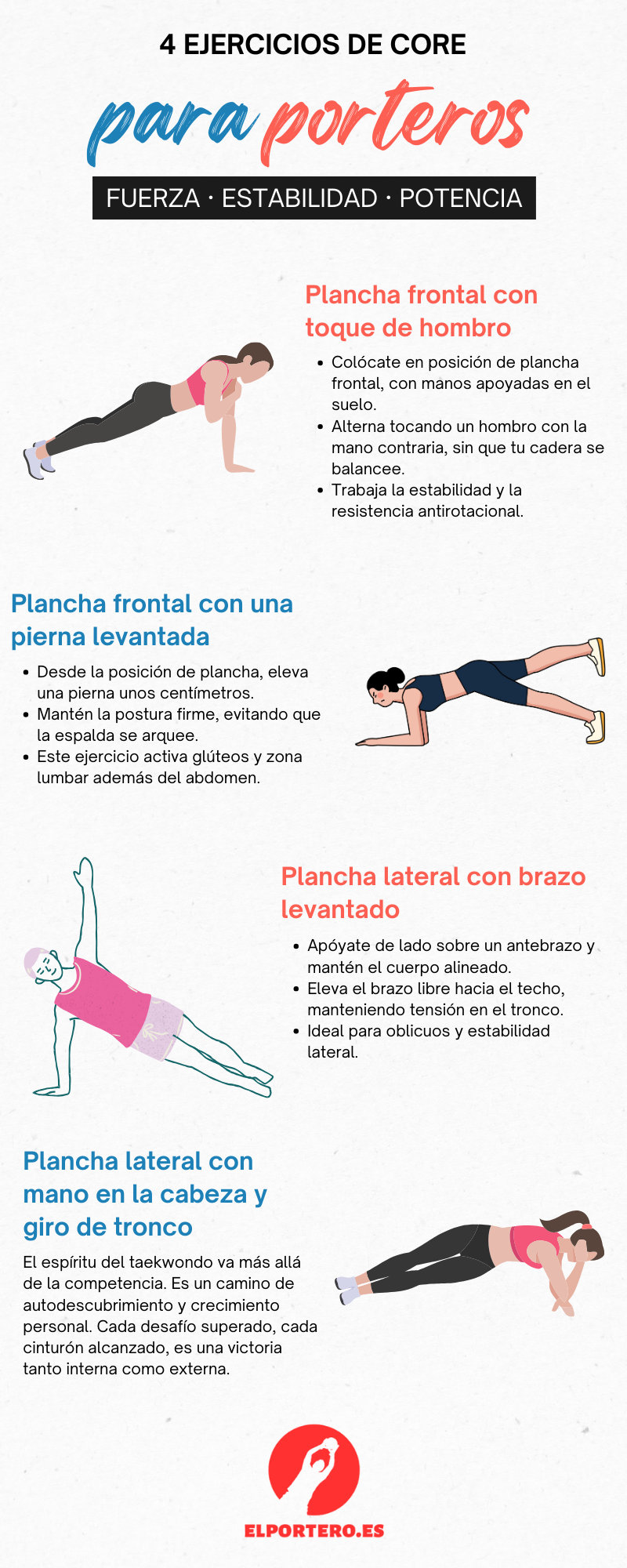
- Plancha frontal con toque de hombro
- Colócate en posición de plancha frontal, con manos apoyadas en el suelo.
- Alterna tocando un hombro con la mano contraria, sin que tu cadera se balancee.
- Trabaja la estabilidad y la resistencia antirotacional.
- Plancha frontal con una pierna levantada
- Desde la posición de plancha, eleva una pierna unos centímetros.
- Mantén la postura firme, evitando que la espalda se arquee.
- Este ejercicio activa glúteos y zona lumbar además del abdomen.
- Plancha lateral con brazo levantado
- Apóyate de lado sobre un antebrazo y mantén el cuerpo alineado.
- Eleva el brazo libre hacia el techo, manteniendo tensión en el tronco.
- Ideal para oblicuos y estabilidad lateral.
- Plancha lateral con mano en la cabeza y giro de tronco
- Desde la plancha lateral, coloca la mano libre detrás de la cabeza.
- Gira el tronco llevando el codo hacia abajo hasta casi tocar el suelo.
- Excelente para trabajar la rotación del core, fundamental en el portero.
Estas cuatro variantes son perfectas para porteros porque combinan estabilidad, fuerza y control en diferentes planos de movimiento.
Cómo integrar el trabajo de core en la rutina del portero
El entrenamiento de core debe incluirse al menos 2-3 veces por semana. Puedes hacerlo:
- Al inicio del entrenamiento, como activación.
- Al final de la sesión, como complemento.
- En casa, en días de descanso activo.
Lo importante es la constancia y la progresión: comienza con series de 20-30 segundos por ejercicio y aumenta poco a poco hasta 45-60 segundos.
Conclusión
El core es mucho más que abdominales. Para un portero, significa estabilidad, potencia y prevención de lesiones. Con solo unos minutos de trabajo específico, puedes notar una gran diferencia en tus blocajes, saltos y caídas.
Así que la próxima vez que pienses en tu preparación física, no olvides entrenar tu zona media. Tu rendimiento en la portería lo agradecerá… y tu espalda también.